Bipin’s website (well, that’s one of them)
Bin’s latest book:

IDEP’s appeal to assist survivors of the Padang Earthquake
www.idepfoundation.org
Dear Friends of IDEP,
Thank you so much to everyone who has sent questions about whether IDEP will be working in the Padang area to assist with the ongoing recovery efforts after the recent earthquake. Following is an overview of IDEP’s plans to work with our local partner in the area KOGAMI to assist some communities that seem to have been “forgotten” to start recovering their lives.
Background
At 10:49 am on March 6th 2007, West Sumatra experienced an earthquake which measured 6.2 on the Richter scale. The epicenter of the earthquake was 50 km from the major Indonesian City of Padang. A second earthquake struck at 12:49 pm. Tremors were felt as far away as Malaysia and Singapore, 430 km from the epicenter.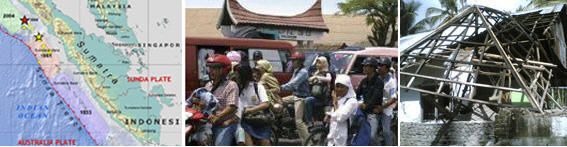
Map of the epicenter of the quake – people in Padang fleeing the area – example of one of the many destroyed buildings due to the quake
The most affected district was Solok, located 96 km northeast of Padang. Tanah Datar, Agam, Padang Pariaman, and the cities of Bukittinggi, Padang Panjang, Pariaman, and Padang were also affected by the earthquake. Thousands of buildings collapsed, glass doors and windows shattered, power lines toppled and phone lines were either cut or overloaded. Over 135,000 people were left homeless.
Padang is considered one of the highest risk areas in Indonesia for Tsunami and earthquake vulnerability. Please see the following TIME Magazine article which explains why: www.time.com/time/magazine/article/0,9171,1139873,00.html
Considering the high level of infrastructure damage, the loss of lives from this massive earthquake was much less than expected with a little over 70 people reported deceased. IDEP believes that this result is partially due to the extensive disaster preparedness work and community evacuation drills that have been facilitated in the area over the last 2 years by our partner KOGAMI.
KOGAMI are a highly effective group of volunteers tirelessly working to educate the people of Padang and encourage the local government to take the risk of earthquakes and tsunamis seriously. KOGAMI have been utilizing IDEP’s Community Based Disaster Management Kit in their efforts to educate the local population of Padang and have been a major catalyst and facilitator for education and training.
KOGAMI has undertaken disaster preparedness training and socialization in every Kelurahan or area around Padang. Their continuing efforts have resulted in a noticeable growth in awareness, preparedness, and anticipation of disasters within local governance and the community. For more information about KOGAMI see: http://www.kogami.or.id/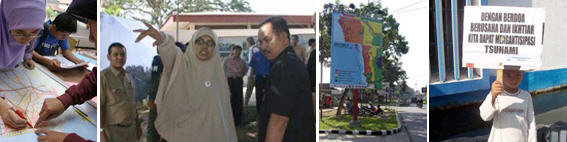
IDEP’s local partner KOGAMI at work in the area – KOGAMI’s Director Patra explains plans to the Mayor of Padang – Area Evacuation Map
Immediately following the earthquake KOGAMI began working with The Fire Department of Padang to undertake extensive Search and Rescue while conducting a rapid needs assessment for the area.
The International response to the disaster was good with the International Civil Defence Directory, International Committee of the Red Cross (ICRC), International Federation of Red Cross and Red Crescent Societies (IFRC), UN Children’s Fund (UNICEF), UN Development Programme (UNDP), UN High Commissioner for Refugees (UNHCR), UN Human Settlements Programme (Habitat), UN Office for the Coordination of Humanitarian Affairs (OCHA), UN Population Fund (UNFPA), UN Resident Coordinator, World Food Programme (WFP) and the World Health Organization (WHO) all working on the ground relatively soon after the disaster happened. Due to this fact IDEP / Kogami decided that it was not necessary to launch a direct emergency response initiative.
Due to the large number of organizations working on the ground after the earthquake IDEP / KOGAMI decided that it was not necessary to launch a direct emergency response initiative following the earthquake.
However, in the period after the quake KOGAMI continued to monitor the response and recovery efforts in the area and found that certain areas had been overlooked and did not have access to the support they needed. KOGAMI then conducted a detailed assessment of these seemingly “forgotten” areas and their findings are the basis for this appeal.
Our plans to assist Earthquake survivors in the Padang area
Buildings in the Padang area are particularly prone to the devastating effects of earthquakes due to their construction methods. The majority of buildings around Padang are highly prone to collapse during a seismic shift. With the reconstruction of thousands of buildings now needed in the area it is important that new appropriate technologies for earthquake proof construction be socialized in the area.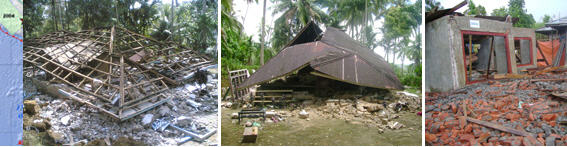
Examples of the many completely destroyed homes that KOGAMI has identified, these families need help to rebuild their homes & lives
IDEP / KOGAMI propose to:
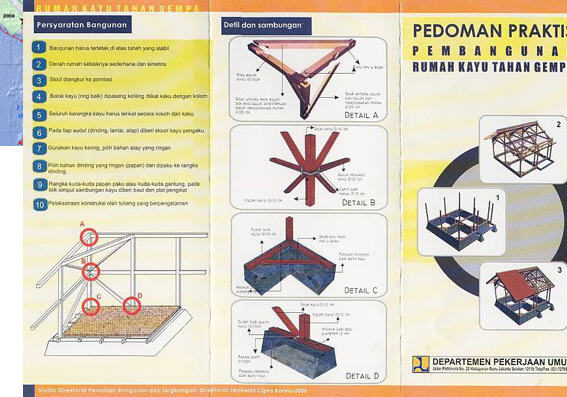
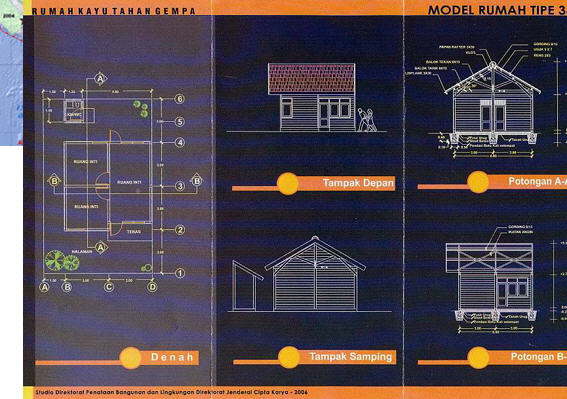
Construct at least one ‘earthquake-proof’ house which will be used as a training and educational model for the community, local government, reconstruction agencies and key stakeholders in the Padang Pariaman area. The cost of this construction and training will be US $9,000. The wooden house that IDEP / KOGAMI plans to construct for demonstration and educational purposes, has been engineered to withstand movement during earthquakes and can be replicated by communities and agencies in the area. Please see the diagram below for the design of the earthquake proof houses.
Many people in remote areas on the outskirts of Padang have not had the support that they need to even start to cover the basic living needs.
IDEP / KOGAMI propose to:
Supply at least 9 complete sets of household needs kits for families who are having difficulty recovering from the quake. These kits will include basic food needs, bedding, and kerosene lamps. These sets (including cost of distribution to families in need) have a value of US$ 300 per set, minimum support needed to implement this activity is US$ 2,700.
People in the Padang area are extremely prone to disaster and ongoing community education and capacity building for disaster preparedness and management is a priority issue in the area.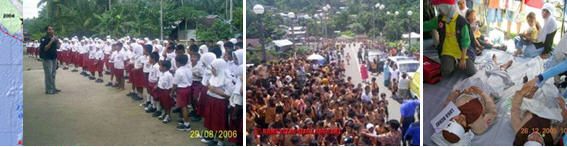
The KOGAMI team at work conducting evacuation drills and teaching basic techniques for Search & Rescue & Emergency First Aid
IDEP / KOGAMI propose to:
Conduct community events and workshops which will increase awareness and understanding in local communities and local government about appropriate systems for building earthquake proof homes and Community Based Disaster Preparedness.
This project will not only provide rebuilding and relief to specific families in desperate need but also act as a working example of effective building techniques for earthquake prone areas.
Should support for this initiative be forthcoming the KOGAMI team will work in the area for 4 months to socialize the earthquake-proof building technology, build the demonstration home in conjunction with local community representatives and other stakeholders and ensure that the technology and information is disseminated to local communities and government agencies. KOGAMI will also distribute the household needs kits while documenting the entire process and reporting on the results.
How you can help…
IDEP is urgently seeking immediate support for assisting affected communities with some basic reconstruction while educating local stakeholders in earthquake proof housing technology.
To make a donation please go to our website: www.idepfoundation.org/idep_donate.php
Currently, IDEP can accept donations by two means:
1) Online Credit Card Donations through the National Heritage Foundation
Visit www.idepfoundation.org/idep_donate.php and select the ‘On-line Credit Card Donation’ option. You will be directed to the National Heritage Foundation website where you can process your donation through their secure site. Donations are accepted on our behalf by the National Heritage Foundation in the USA which is a registered 501-(c)(3) charity. Donation made through NHF are tax deductible in the United States.
Don’t forget, when you register your donation on our website, if you wish to earmark the funds for a particular project please indicate the project name.
2) Wire transfer to our bank account
[see website for details bank transfer details…]
If you are wire transferring funds please notify IDEP by filling in our donation registration form on-line at: www.idepfoundation.org/idep_donate.php or emailing donate@idepfoundation.org. Please indicate the amount, the originating currency (i.e. US dollars, UK pounds, etc), bank name and city from which the transfer was made, your name (as you would like to be listed on the donor list), and the date of the transfer. A receipt will be sent once the funds have arrived. Also, if you wish to earmark the funds for a particular project please indicate the project name.
Thank You so much to everyone who can help make this recovery project possible and for any support you are able to provide.
Overview of Earthquake Proof Housing Technology that will be used as part of this project:
Check out this post from Mike Dodaro, which begins with:
What else do you need to know about the Entity Framework? We’ve documented basic syntax and provided a few samples. How can we improve the documentation? Send us scenarios you want to implement.
Somasegar announced (with great pride) the availability of the first Beta of Visual Studio Orcas a few days ago. There is a huge VPC available for download, but also express versions. Some other varieties (perhaps an MSI installer) are coming on MSDN Subscriber downloads as well. READ MORE
[A New DevLife post]
[A New DevLife post]
Wierd connection right? But ever since I started using Vista, I have had the song “Have a Heart” (from Nick of Time) pop in my head frequently. There is something about the tone and length of the “Default Beep” (Windows Ding.wav) that matches the very first “Hey!” of that song! (Though of course Bonnie Raitt sings it a million times lovlier than my computer.) It’s crazy. “I can name that tune in one note!”, right? But still, every single time that beep sounds, the tune starts up in my head and I finally had to share this.
The joke here is that Microsoft actually hired Robert Fripp to create the many of the sounds in WIndows Vista, though I don’t think the little Ding comes from anywhere but a computer.
Tablet PC/Ink related sessions & HOLs I see on the MIX site:
SESSION:
Ink for Designers and Developers
Speaker(s): Sam Geroge – Microsoft
Audience(s): Designer, Developer
Imagine if your users could add handwritten annotations over online photos, greeting cards or video (including live playback of your handwriting). Learn how to use Ink to take your Web sites to new heights of interactivity, personalization, social interaction, and usability. Learn the key design principles for Ink, and see how to code for Ink in the browser and on the server.
HANDS ON LAB:
Ink in Web Applications
Audience(s): Business Decision Maker, Designer, Developer
Adding ink and annotations makes your Web applications far more interactive and enables users to add their own personal touch. This lab shows just how easy it is to add ink and annotation, which integrate seamlessly with other features of Web development. You will become familiar with a Web page for browsing photos; implement ink support; change the thickness and color of the ink; implement erasing with the back of the pen, and more.
(I think there are more HOLs. I just don’t see them on the site yet)
I found some interesting ADO.NET labs and sessions on the MIX site today!
SESSIONS
Accessing Data Services in the Cloud
Speaker(s): Pablo Castro – Microsoft
Audience(s): Designer, Developer
Come learn about new Microsoft technologies that enable you to make your data available over the Web through a simple REST interface and using open formats such as plan XML, JSON or even RDF. We also discuss the underlying entity framework that makes it easy to model, publish, and program against your data over the Web.
Rapidly Building Data Driven Web Pages with Dynamic ADO.NET
Speaker(s): Samuel Druker – Microsoft, Shyam Pather – Microsoft
Audience(s): Developer
Come learn about how new technologies from Microsoft bring together the concepts of dynamic languages and ADO.NET and allow you to quickly develop data driven Web pages using ASP.NET dynamic data controls, scalable to even the most complex databases.
*note that Andrew Conrad wants to make sure you notice the word DYNAMIC in that session!
Deep Dive on Data Driven Experiences
Speaker(s): Aaron Dunnington – Microsoft, Tim Scudder – Microsoft
Audience(s): Developer
Come learn how technologies like Silverlight, Language INtegrated Query (LINQ), and SQL Server 2005 can help developers build impactful, dynamic applications that reach the broadest possible audience.
LABS
REST Services for Data Access over the Web
Audience(s): Developer
In this lab, build a data service accessible through REST that supports exchanging data in XML and JSON formats, with full query and update capabilities; and build an AJAX-based client and a managed code client.
Rapidly Building Data Driven Web Pages with Dynamic ADO.NET
Audience(s): Developer
In this lab, learn about Project Friday, an incubation effort in the ADO.NET team to enable quick, clean, and iterative development with instant results. Project Friday provides this functionality by leveraging the ADO.NET Entity Framework and the power of dynamic languages.