I finally noticed that Service Pack 1 for Visual Studio 2005 corrected two of the problems that I’ve mentioned in previous articles and blog posts about ClickOnce. read more…
[A new DevLife post]
I finally noticed that Service Pack 1 for Visual Studio 2005 corrected two of the problems that I’ve mentioned in previous articles and blog posts about ClickOnce. read more…
[A new DevLife post]
I was there in the incredible (not very eastern-skiing-like) powder on Friday, but didn’t stay long and had to come back home for a conference call. This is how I dream of skiing, but I don’t come close.
As someone who flies quite a lot, I am always interested in stories and news about airline flights. Today’s CNN story about a Northwest flight out of Las Vegas being cancelled because the pilot (I can’t believe this, yes the pilot!) was causing a disturbance (swearing up a storm and even at the passengers) that resulted in the police being called. Definitely something not right there and obviously, not at all normal. Talk about killing your career.
The fact that the flight was cancelled and the 180 passengers are now stuck in Las Vegas as a result of this definitely sucks.
They probably wouldn’t be in the mood to watch this hilarious t.v. ad for the psycho stewardess who is trying to quit smoking. I wonder if that is what was wrong with the pilot?
I have definitely not had either of these experiences when flying.
There are a lot of us who have been looking forward to this show being posted: Daniel Simmons on ADO.NET Entity Framework. Now I have to find some time this weekend to listen to it. Roger Jennings has a fantastic analysis of the show here. While at DevConnections, Richard and Carl were talking about how much fun this show was to do. They didn’t know anything about Entity Framerwork when they started and were definitely fascinated with it. I’m glad that more people are going to get exposed to EF!
At what point in a project do you start wanting to grab the remote and start flipping the channels? Camey Combs talks about losing that loving feeling on a recent project which, until then, had been filled with intriguing challenges. read more…
[A New DevLife post]
Mad River Glen (which is open today since we had a big dump of snow and it’s beautiful out and I’m tortured because I need to work… uggh) is going to begin a major restoration of it’s historic and world famous Single Chair lift next week. To raise funds, they have been auctioning off the old chairs. The VERY LAST chair is now being auctioned off on eBay.
It’s not often that one sees their name right next to Anders‘ (especially considering that I’m a VB programmer :-)), but check out this LINQ article in the current issue of Redmond Developer News. While the focus is Anders and this great technology he and others (and always with a nod to Alan Griver) are bringing to Visual Studio .NET, I was asked to give some developer perspective.
I’d also like to say that I wasn’t literally jumping up and down at PDC. 🙂
I know that I have had the same reaction when watching Scott Guthrie present on LINQ to SQL. I think I’m jumping up and down with joy, but truly my butt remained glued to the chair.
It was fun talking to Michael Schwarz about this, but I think I may have overwhelmed him with my geek technical perspective of LINQ from which he was trying to extract key points for dev managers. He seems to have done a great job.
Michael talked to another developer, VB guru Bill McCarthy who gave him a great analogy quoted at the end of the article.
A recent LINQ forum question asked about the differences between Linq to SQL and the Entity Framework.
This is the response that I wrote and thought I would surface it in my blog:
Besides that Linq to SQL is only for SQL ( ) one of the big differences is that the EDM is more flexible and more loosely coupled because of the 3-tiered model (conceptual layer, source schema and the mapping layer in between). For example, you could have one conceptual layer and then multiple mapping layers that point to mulitple databases. In LINQ to SQL, your dbml properties are tightly bound directly to one particular field in a table.
While these are not in the March 2007 CTP, EDM is getting the ability to build views of the conceptual layer as well as to write stored procedures in the mapping layer. These are really cool features. I don’t believe you can do this with Linq to SQL, but a) I could be mistaken and b) that may be something that is forthcoming.
In addition to Linq to Entities, Entity SQL can be used to query entities. This can be either through the object services API or the Entity CLient (the one which gives you connections/commands and results in a dbDataReader). Entity SQL, while not as elegant as using the strongly typed LINQ, has the advantage of enabling dynamic queries, since you use a string to build a query, much like TSQL.
Both Linq to SQL and EDM allow inheritance and extending the code generated class with addtional partial classes. EF allows many to many relationships. I believe that LINQ to SQL will NOT be getting this by RTM.
These are just a few points and hardly exhaustive. But to me they are the low hanging fruit.
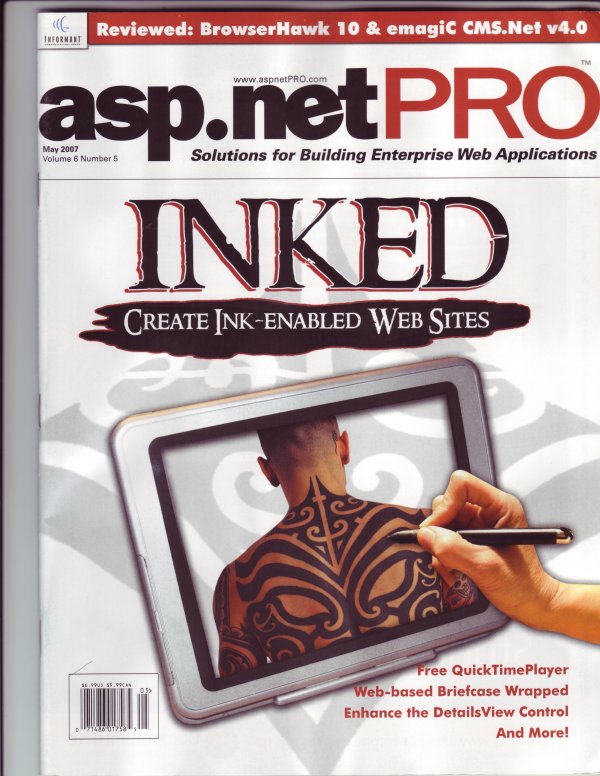
My latest asp.netPRO article is about ink-enabling web sites and is aimed at web developers who are new to the ink APIs for TabletPC development.
I LOVE the cover they did for this issue. Coooooool, huh?
Fabio Claudio Ferracchiati has a book on LINQ that he wrote against very early bits. When the March 2007 CTP came out, he blogged a list of things that he discovered had changed in LINQ syntax that required updates to his book. The list is handy if you have code even from the January CTP.