http://www.AcehAid.org
Monthly Archives: March 2005
Ari Bixhorn’s Indigo Keynote from Web Services Edge East is online
DevTeach 2005 Speakers
http://www.AcehAid.org
Dino E on Partial Classes
Dino Esposito has an article in the current Code Magazine called “Implications and Repercussions of Partial Classes in the .NET Framework 2.0“. It is a good, thoughtful look at partial classes, what you might want to do with them, where they are obviously beneficial, and where they are possibly beneficial. One of the approaches he was suggesting (as doable, not necessarily a best practice) was using partial classes (in SMALL apps) to organize your business logic, data logic, etc. As I was reading that part, my temperature started to rise and then I got a great laugh when he writes:
“Is this approach recommended? It depends. It surely provides you with an alternative. If you’re a design and OOP puriset, you’re already putting a curse on me. So, guess what? In this case, I woulnd’t even suggest this to you. Onthe other hand, if you’re moroe open-minded and used to looking at final results, you might want to take a closer look at this approach.”
http://www.AcehAid.org
More on System Types vs Language types
Geeze – nearly 3 years of working in .NET and I just noticed this today – ’cause I went looking for it.
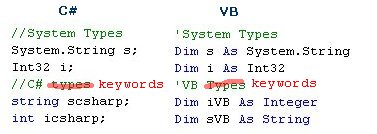
For the super curious (and this hardly satisifes anything beyond that), how do you know when you are using a system type vs. a “keyword“? It’s easy with VB’s Integer (keyword), or C#s int vs. Int32, but what about String and System.String?
But now I see it….

Note the text color of the System types vs. the text color of the language keywords. Subtle. Not earth shattering, but still interesting. In a why is the sky blue kind of way…
http://www.AcehAid.org
More Powder days on the way
well it’s about time winter finally arrived in Vermont!
“Winter storm watch in effect from Monday afternoon to Tuesday evening”
http://www.AcehAid.org
Looking forward to 3 hour WSE for Humans Workshop at DevConnections
As I am looking at my presentation for the 3 hour workshop I am doing on WSE Security at Connections in a few weeks, I am really excited about it. This the first time I won’t have to cram all of this information in a short session – or skip a lot of it. I am going to have plenty of time to go over the security fundamentals as well as the basics of WSE 2.0, such as what they are, how they work and how to work with the API and Policy.
Remember that this is not a regular session at ASP.NET Connections, but a pre-conference Workshop on Sunday afternoon, which you have to register for additionally. There don’t seem to be any other WSE 2.0 focused talks at the conference, although there will be some Indigo sessions and Christian Weyer and Malek Kemmou will be doing sessions on Web Services . So if you want to get started with WSE and also be prepared to start learning about Indigo, I highly recommend the extra session so that you won’t feel lost at the higher level ones!
http://www.AcehAid.org
Mainstream support for VB6 coming to an end March 31st
Jackie Goldstein points out this important reminder.
What’s changing:
Extended Phase (through March 2008)
- [Still have] Standard support offerings include Premier Support, paid telephone and online incident support, and free online self-help tools.
- Critical Updates will be available for a fee.
- Free telephone and online incident support will no longer be available.
Don’t throw out those old MSDN Library DVDs!!! (Though the online support won’t go away for 3 more years.)
http://www.AcehAid.org
Congrats Drew Robbins – new Microsoft Developer Evangelist!
Drew Robbins, who I have known since the beginning of my INETA days as a very involved user group leader as well as someone who has been a great community leader in Ohio, has just become the D.E. for Ohio, Michigan and Kentucky. Many of you may also know Drew as the co-creator of PDCBloggers.net and TechEdBloggers.Net as well as a few other compilations.
Drew replaces Alex Lowe who has been, from all accounts, an awesome D.E., but just couldn’t resist the call to go work with his ASP.NET homies at Telligent Systems.
http://www.AcehAid.org
C# string and String
As I’m digging further into my C# for VB6 programmers talk that I am preparing for Code Camp and also DevConnections, I noticed something funny – that case-sensitive C# doesn’t seem to care if you use String or string – while it cares plenty if you try to use “Int” or “Bool”, etc.
I realized though that it is really because string is the C# type and System.String is the .NET type, so they both are okay. So byte/Byte are both okay but you can’t get away with int/Int32 or bool/Boolean. The funny thing is that when I am coding in VB, I try to use the framework types. I always use Int32, never Integer. But I was trying to be a cool C# coder, so I was using the C# types instead. Go figure! Actually in VB, Integer is more work than Int32, but in C# int is faster than Int32. So that’s probably my good excuse, eh? Anyway, these seem like silly things, but definitely will make a VB coder stop and think for a minute which is why I’m doing my best to try to save them a few steps!
This talk is almost just as easily C# for VB.NET programmers, except that since there were syntax changes from VB6 to VB.NET, I will be incorporating the VB6 perspective as well.
http://www.AcehAid.org