Daily Archives: September 22, 2007

Timothy Ng from the Visual Basic team is coming to speak at New England Code Camp!

Boy am I excited about this.

Timothy Ng is on the VB team and wrote the recent MSDN Magazine article on Lambda Expressions for VB developers. I understood lambdas better than ever after reading the article … finally something from the VB perspective.

His two talks are:

LINQ-ing your data
In this session, I will explore how LINQ will change the way you think about data in your applications. In particular, I will explore how LINQ provides a higher abstraction for accessing your data, provides a common abstraction across data domains, and allows for simplified data transformations. I will focus on LINQ to XML as the transformation technology, and the various XML features that are available in VB.

LINQ from the Ground Up
In this session, I will explore the fundamentals of LINQ by examining how the various language features (such as extension methods, type inference, lambda expressions, and anonymous types) form the foundation for LINQ. I will share some of the experiences that the VB compiler team had while building LINQ, in hopes that it will help you build your applications on LINQ. Examples will be in VB, but this talk applies to C# folks who are interested in learning how the fundamentals work as well. All language concepts apply to both VB and C#.

I sure wish I was seeing these before I do my LINQ talk in San Diego on Tuesday! 🙂

Richard Hale Shaw will be doing some pretty cool LINQ talks too which will be a C# focus.

Before I learned that Tim was coming, I was already excited about the Code Camp speaker roster. This will be the first time that Jesse Liberty and Fritz Onion (who are “local” in about the same way that I am local… well, I guess Fritz’s drive is even longer than mine). Jesse recently started working for Microsoft (see? I managed not to say “swallowed the red pill”!) and he is “da man” at Microsoft on Silverlight. Fritz is a true ASP.NET plumber who amazed us all with his book Essential ASP.NET in the .NET 1.0 days and again with the updated version for ASP.NET 2.0, because it explained HOW ASP.NET actually worked and he continues to spelunk on our behalves.

There are already almost 40 sessions listed with tons of amazing expertise on display.

I’ll be doing a talk on Astoria, a session on using Entity Framework in multi-tiered apps (and getting a little nervous that nobody seems to be doing an Intro to entity framework session) and a session on ASP.NET Databinding with LINQ.
Trying to see what Astoria messages look like in the pipe

I don’t like not knowing how something works, so I just had to dig further into how Astoria services see requests for queries versus Updates, Deletes and Inserts.

In my previous post, I dug into the assembly with reflector and could see that a PUT was used for updates, DELETE for deletes and POST for inserts.

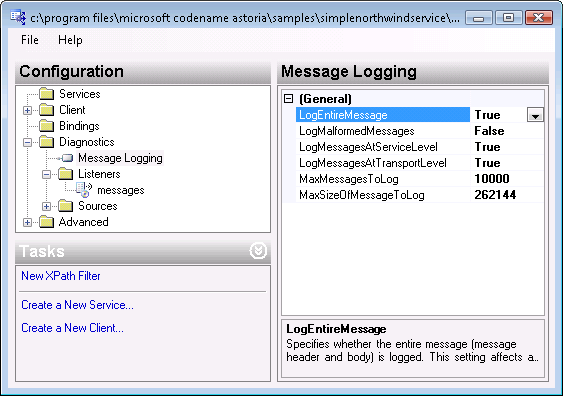
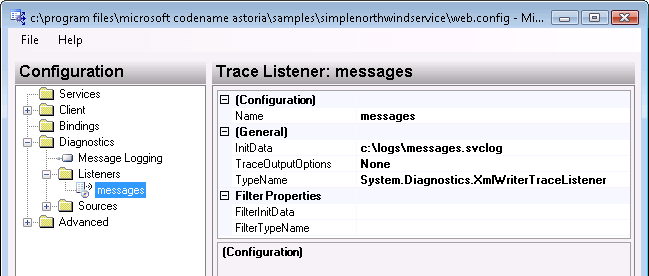
I turned tracing on for the Astoria service and pushed the trace info to a log file. You can see how to do that at the end of this post.

Looking at the messages, you can see the METHOD and the query operators but not the main call. 🙁

For example if I made a call to service.svc/Customers the message looks like this. I’ve stripped out WebHeader information from the message.

<HttpRequest xmlns=”http://schemas.microsoft.com/2004/06/ServiceModel/Management/MessageTrace“>
<
Method>GET</Method>
<
QueryString></QueryString>
</HttpRequest>

I don’t see that I called the Customers “operation”.

If I request service.svc/Customers[52], it’s the same. I don’t see the Customers and I don’t see the ID i’ve passed in.

If I use a query operator as in service.svc/Customers[City eq Seattle], it’s still not exposed. Now I’m getting frustrated. I know I’ll have to dig deeper at some point, or bribe Pablo to show me someday.

But for now here’s a little gratification. If I create my own Service Operation which takes a query string, now there is something to see. My service operation is CustomersbyCity. the call looks like this

service.svc//CustomersByCity?city=London

The message looks like this

<HttpRequest xmlns=”http://schemas.microsoft.com/2004/06/ServiceModel/Management/MessageTrace“>
<
Method>GET</Method>
<
QueryString>city=London</QueryString>
</HttpRequest>

When I use my little console app as a client and do some inserting and deleting, I can see the methods coming up the pipe, remember, the Astoria.Client.dll translates the function (insert/update/delete) into a Method.

<HttpRequest xmlns=”http://schemas.microsoft.com/2004/06/ServiceModel/Management/MessageTrace“>
<
Method>DELETE</Method>
<
QueryString></QueryString>
</HttpRequest>

So, only MILDLY interesting to me (because I can’t get in deep enough yet) and probably COMPLETELY uninteresting to most everyone else. But it was fun digging around and also learning how to use some of the WCF tool. Here by the way is how I got to see the messages.

Modify the web.config to “Turn On” tracing and messaging. You can do it manually or with a tool.

    <system.diagnostics>
        <sources>
            <source name=“System.ServiceModel.MessageLogging”>
                <listeners>
                    <add name=“messages”
                    type=“System.Diagnostics.XmlWriterTraceListener”
                    initializeData=“c:\logs\messages.svclog” />
                </listeners>
            </source>
        </sources>
    </system.diagnostics>

    <system.serviceModel>
        <diagnostics>
            
<messageLogging logEntireMessage=“true” logMessagesAtServiceLevel=“true”
               logMessagesAtTransportLevel=“true” />
        </diagnostics>
    </system.serviceModel>


You can use the WCF Config tool in Visual Studio 2008 to configure this. Right click on the web.config and choose Edit WCF Configuration. Here are screenshots of the settings that created the above in my web.config.

If you are using the Web Dev server, you need to stop that server so that the trace actually gets written to the file before you can look at it.

Once the file is created, you can look at it using the Service Trace Viewer which you can find in the SDK Tools (available from Start/Program Files/Microsoft Windows SDK for Visual Studio).

Astoria is sick (as in SLICK) when it comes to DML!

I got bored with querying Astoria in the browser and and wanted to see how to use it in an application, so I opened up the sample console app that comes with the bits and started poking around and was astonished at what I saw.

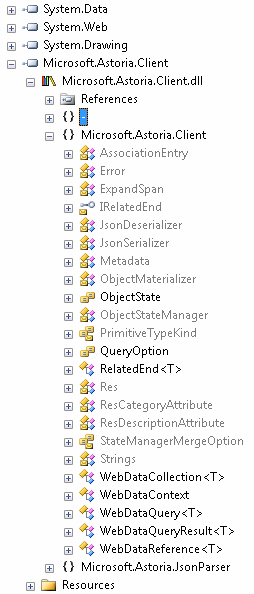
You can create an new WebDataContext based on the Astoria data service.

WebDataContext is like an ObjectContext. Here’s what it exposes:

namespace Microsoft.Astoria.Client
{
public class WebDataContext : IDisposable
{
public WebDataContext(string uri);

public string BaseUri { get; }
public ICredentials Credentials { get; set; }

public void Add(object obj, string entitySet);
public void Attach(object obj, string entityKey, ObjectState state);
public WebDataQuery<T> CreateQuery<T>(string queryString);
public WebDataQuery<T> CreateQuery<T>(string queryString, QueryOption queryOptions);
public void Delete(object obj);
public string[] GetEntitySets();
public void MarkModified(object obj);
public void SaveChanges();
}
}

So, you can create a WebDataContext

WebDataContext ctx = new WebDataContext(“http://localhost:50000/northwind.svc”);

then query it

Category beverages =
ctx.CreateQuery<
Category>(“/Categories[CategoryName eq ‘Beverages’]”
)
.FirstOrDefault();

add a new object to the ObjectContext

Category newcategory = new Category();
newcategory.CategoryName =
“Sample”
;
ctx.Add(newcategory,
“Categories”);

And then (this is the part that is sick and I want to rip open the covers and see how they are pulling this off!), call SaveChanges on the context!

ctx.SaveChanges();

Of course, you can update and delete, too.

So, I wanted to see what’s going on here. It’s REALLY important to understand that we’re looking at prototype bits. THe production code that they are working on now will be different, though the concepts and use will be relative to what we can play with today.

You can’t get any hints by adding ?WSDL to the end of the uri. Rembmer withi a default asotira service, there are no operations. It’s all based on interpreting the URI. So I opened up Reflector and pointed to the key assembly.

SaveChanges calls a method called SendHttpEntityUpdate which sends up the object and the key and based on the operation calls a request method. So if you are adding, it sends a POST. If you are deleting, it sends DELETE and if you are modifying it sends PUT. The dll used by the service checks which method you pushed up (there’s an enum for ReceiveEntityOperations) and processes the incoming data accordingly.

Neat!

So of course there will be the usual million concerns about this. There are definitely credentials built into these operations and all kinds of ways to limit what is available thorugh the web service.  And there’s so much I don’t know yet, so don’t judge solely on what you are seeing here.

If you don’t have a .NET Astoria client, you can just construct the POST, PUT and DELETE URIs. I can’t say how to do that quite yet though. 😉 (Not that it’s a secret. I just don’t know how yet.)

But it’s still darned cool. Nice job folks (and don’t forget Alex who was key in getting Astoria going before he left Microsoft! )

More fun with Astoria – random queries in the browser

I find it helpful to use the browser to visualize immediate cause and effect of queries to an Astoria web data service. THere’s so much more that you can do when you are really using this in applications, though.

In the documentation there’s a list of query operators:

  • callback (specific to JSON for AJAX calls)
  • expand – pull related data using EDM associations
  • format – define format of the response (eg xml, json, rdf)
  • keyset- only return the entityKeys
  • orderby (you know what this is)
  • skip (same as in LINQ)
  • top

The doc explains each of these in more detail.

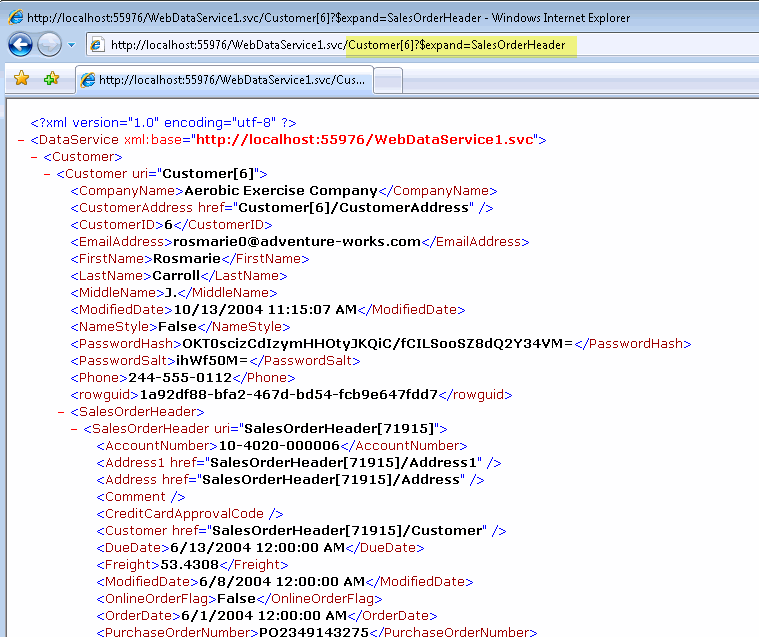
Here for example, I can get a specific customer and all of their sales order headers. (Make sure you have MultipleActiveResultSets=true in your connection string in order to do this. That allows the db to return more than one result on the same connection string .. a feature added in that we first acquired with .NET 2.0 and SS2005.)

I can drill even further to return the SalesOrderDetail data form the SalesOrderHeader using this URI:

http://localhost:55976/WebDataService1.svc/Customer[6]?$expand=SalesOrderHeader.SalesOrderDetail

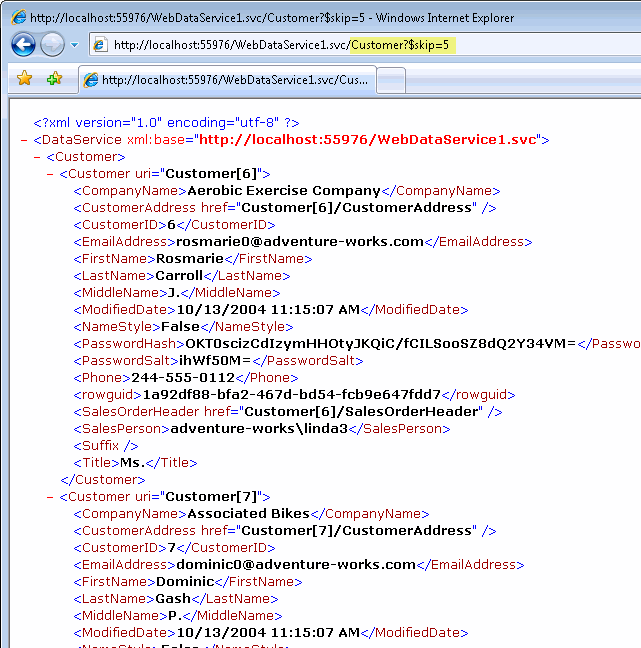
Here’s an example of using skip

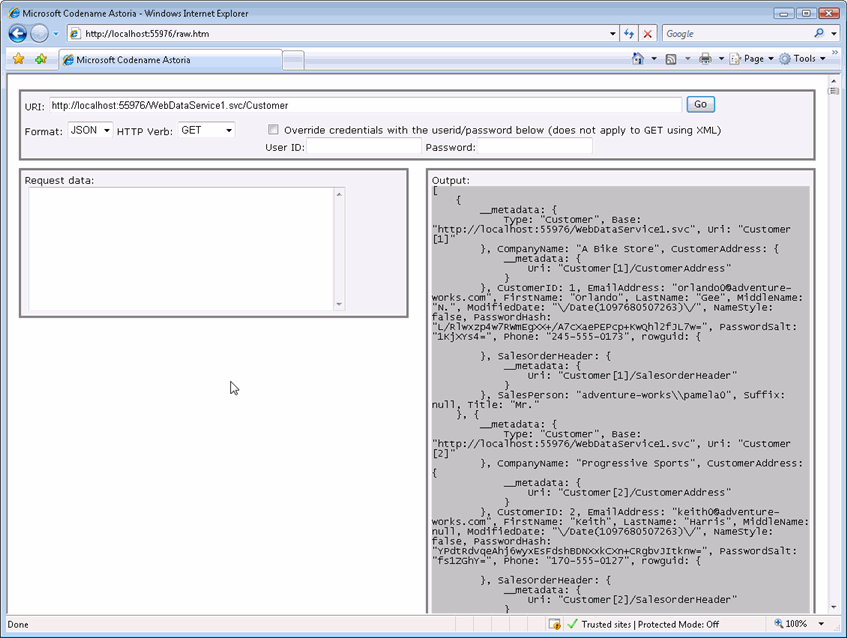
Looking at the non-xml formats is tough in Internet Explorer, at least with JSON as IE doesn’t know how to display the response. There are a few ways around this.

1) (bit of a hack :-))

Add this into the appSettings seciton of web.config

  <add key=”EnableAstoriaJSONP” value=”true”/>

and then browse your service in Firefox, Firefox will ask you waht you want to view the response in, choose notepad and you can see the json response. Read the caveats about JSONP in the Astoria documentation.

2) Use the helper tool which is an HTML page here [ http://astoria.sandbox.live.com/tools/raw.htm ]. You can’t use this online (I know ’cause I tried in my impatience!). You need to download it and add it into your project. It will then properly parse and display results.

So all this is just about querying, the “R” (read) in CRUD. Wait till you see the C, U & D. Watch for another post.