All posts by Julie

Publish Powerpoint to Word to add notes to handouts

I’m in SHOCK. I just learned about this option that I’ve always wanted in poweropint.

When I present I always print out a set of 3 per page handouts then write notes to myself about demos in the area to the right.

I often lose or throw away my notes and kick myself next time I want to do the presentation.

I came across Tip #2448 – Creating Custom PowerPoint Handouts in MS Word  on the web when I finally entered the right combination of words in google and realized that the functino exists RIGHT IN Powerpoint. In Powerpoint 2007 it’s in the Publish menu.

ObjectQuery, LINQ to Entities and IQueryable

The return type of a LINQ query is an IQueryable, even a LINQ to Entities query.

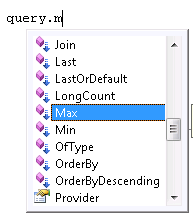
Here is a screenshot of a LINQ to Entities query at design time (code is NOT being debugged).

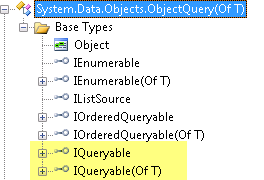
But when the query has been processed, it’s no longer an IQueryable, but an ObjectQuery.

What’s going on here?

At design time, the compiler recognizes that it’s a LINQ query and therefore assumes the return will be an IQueryable.

However LINQ to Entities queries are sent to ObjectServices which return an ObjectQuery, so after it’s processed, it is actually an ObjectQuery.

So, since it’s an ObjectQuery after all, wouldn’t it be nice to leverage ObjectQuery features like MergeOptions on a LINQ to Entities query? You can!

But how? At design time, the query is an IQueryable, not an ObjectQuery and doesn’t have MergeOptions.

No worries. ObjectQuery implements IQueryable.

So you can cast the LINQ to Entities query to an ObjectQuery, set the MergeOption and, as Jeffrey Palermo would say, party on the LINQ to Entities query (though he may not be likely to say that in the context of Entity Framework ;-)).

Using context As New AdventureWorksLTEntitiesDim query = From c In context.Customer Where c.LastName.StartsWith(“S”)Dim objquery = CType(query, ObjectQuery(Of Customer))objquery.MergeOption = MergeOption.OverwriteChangesDim cust = query.ToList.FirstConsole.WriteLine(cust.LastName)cust.LastName = cust.LastName.Trim & “___XYZ”cust = query.ToList.FirstConsole.WriteLine(cust.LastName)End Using

Notice that I’m still performing the operations against the  LINQ query after I cast it to the ObjectQuery.

I could also have done something like

Dim custs = objquery.Execute(MergeOption.OverwriteChanges)

Thanks to Danny for reminding me about the casting! The blog post is intended to lock it into my brain.

Compiled Queries in Entity Framework

I was fiddling with compiled queries yesterday and thought I would share what I saw as results. This is anything but laboratory benchmark testing so take it for what it’s worth. I did only a very simple query to start with, finding SalesOrders whose total is greater than a given number.

You can do this with Entity SQL or LINQ to Entities. Here is my LINQ to Entities compiled query:

Dim compQuery = CompiledQuery.Compile(Of AdventureWorksLTEntities, Decimal,
 IQueryable(Of SalesOrderHeader))( _
 Function(ctx As AdventureWorksLTEntities, total As Decimal) _
 From order In ctx.SalesOrderHeader _Where (order.TotalDue >= total) _
 Select order)

To interpret this, Compile’s signature looks like this:

Compile(list of args, returntype)(delegate)

It takes a list of arguments and a return type then performs an operation (defined in the delegate) on the arguments. I’m defiining this compilation to recieve an AdventureWorksLTEntities instance and a decimal and the return will be an IQueryable of SalesOrderHeaders.

VB
CompiledQuery.Compile(Of AdventureWorksLTEntities, Decimal, _ IQueryable(Of SalesOrderHeader))
C#
CompiledQuery.Compile<AdventureWorksLTEntities, Decimal, IQueryable<SalesOrderHeader>>

For the delegate, I use a labmda epxression that says what to do with the parameters which is to build the query.

VB
(Function(ctx As AdventureWorksLTEntities, total As Decimal) _
From order In ctx.SalesOrderHeader _
Where (order.TotalDue >= total) _
Select order)

c#
(ctx, total) => 
from order in ctx.SalesOrderHeader
where (order.TotalDue >= total)
select order)


The whole query is tied to a variable

Dim myCompiledQuery=CompiledQuery.Compile(....

Then when I want to run the query, I invoke it and pass in the parameters


Dim AWEntities As New AdventureWorksLTEntities
Dim orderTotal=200
Dim orders As ObjectQuery(Of SalesOrderHeader) = compQuery.Invoke(AWEntities, orderTotal)

The first time the compiled query is run, it still has to compile, but after that it uses the results of the compilation and can swap in the parameters without needing to recreate the generated command tree.

You can see a big difference between running the query without pre-compilation and running it with the compiled query.
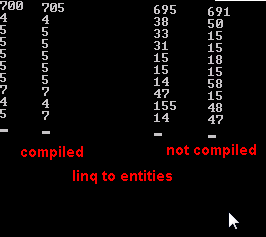
Brian Dawson does some more intense testing and compares LINQ to Entities to Entity SQL as well in this blog post. But I just needed to actually do it myself, rather than only reading about it.

LINQ to SQL also has compiled queries. Rico Mariani has a series of posts on this starting here.


MVC with Visual Basic video series

Bill Burrows has created a series of videos on MVC and is now working on a new series based on Scott Guthrie’s MVC tutorial posts (which are all in C#) but using VB instead. I was surprised to find a pointer to my recent MVC post as a “rare example” of MVC with VB (and it’s only one little post so I found that to be sad) so I’m happy Bill is doing these. It gives a leg up to VB developers who find it hard to try to learn something that is VERY new and convert the C# syntax in their brain at the same time.

Here’s the list of topics covered

  An Overview of the MVC Pattern
  Setting up the MVC Preview Environment
  URL Routing
  Setting up New Pages
  MVC Controller Actions 
  Creating HTML in Views 
  MVC – Putting it all together

Thanks to Beth for the heads up.

nHibernate 2.0 Alpha

Entity Framework owes a lot to the feedback of the nHibernate crew who, as Roger Jennings so aptly states, “were responsible for making the Entity Framework folks finally understand what persistence ignorance is all about”.

The PI side of EF still has a long way to go, so in the meantime nHibernate continues to get stronger and stronger.

The alpha of a new version that logs over 100,000 lines of code changes was just released.

I know those guys are beyond frustrated with the current state of Entity Framework and the persistence of people like me who are curious about it and continue to share what I learn with whoever wants to listen, rather than just telling them to run away from data centric programming and join the ALT.NET wave. But what can I say. I embrace the options even if I can’t become expert in them all.

Anyway, this release is a huge accomplishment and to have it be done with the dedication of what it takes in an Open Source environmnet to roll out a tool that can be used in big enterprise applications is really impressive.

LINQ to SQL (and LINQ to Entities) performance improvements for VIsual Basic

Highlights of this post from Timothy Ng of the VB team:

“Over the last few months, the VB and Data Programmability teams were working on fixing a performance problem with LINQ to SQL (which also manifested in LINQ to Entities). The issue was that LINQ to SQL was generating sub optimal T-SQL queries when the VB LINQ queries included filters over nullable columns.”

“The good news is that the LINQ to SQL team has a fix to their code generation to recognize this pattern, and now they emit the SQL code that you would have expected to emit”

“In other words, LINQ to SQL (and LINQ to Entities – we made the same fix there) is now smart enough to pass three-value logic from VB to SQL.”

Congrats to Matthieu Mezil who became a father yesterday and an MVP today!

I’m not sure which he is more excited about! Just kidding. But considering that his wife is going to let him go to the MVP summit only 2 weeks after their first child is born, it makes one wonder!

Hey Matthieu – what’s this about making fun of being a VB MVP? 😉

Matthieu has spent a lot of time in the MSDN forums answering questions on Entity Framework. Thanks to him, I’ve had time to write my book while he gives the team a run for their money on answering questions. 🙂

Writing Style: Me, Myself and I?

In my blog, I write as though I am just talking and the words me, myself and I appear quite a lot.

When writing technical articles, my editors constantly have to battle the “me myself and I” becuase the article is not supposed to be a story about me. Though I really do like to share those “man, this thing was killing me until I figured out x y and z” type of anecdotal lessons.

As I am writing my book, I have been extremely careful to make the book be about YOU, the reader. Even though I desparatley want to hold your hand and lead the way, I try to be consistent with YOU and even avoid WE as in “and now we’re going to do this”. It takes a lot of thought to figure out how to do this without being completely impersonal because that would just not be me.

Occasionally I have written essays for CoDe Magazine’s MVP Corner and I have an upcoming “End Bracket” essay in MSDN Magazine. These essays are where I get to write about me, myself and I as much as I want. Yay.

I just happened to come across a comment on a recent MVP Corner essay called Meeting Bill Gates. The comment said “Because it’s natural, I had a feeling like Julia Lerman talks face to face with me. Nice”

I just love that comment because this is the way I truly love to write.

Hudson Valley Software Summit in Planning

I used to live in NY State’s Hudson Valley and am always interested in what’s going on there with the software community.

Some folks I know are beginning to plan for a summit to bring together software people from around the region.

They have a website with a survey (on the registration page) to help with planning the summit.

Hudson Valley Software Summit

Here is a copy of the overview on the home page:

The goal of the Hudson Valley Software Summit (HVSS) is to encourage technological innovation in the region. The area is richly endowed with creative people, many of them software developers and entrepreneurs.

The HVSS is an opportunity for these folks to network with each other and to showcase their work for others outside the immediate community, such as potentially interested parties in New York City, Northern New Jersey, Albany, and Boston.Those for whom this event is a must attend occasion include:

  • Venture capital firms
  • Technology firms
  • Internet service providers
  • Private equity firms
  • VC-backed portfolio companies
  • Angel investors
  • Professional service providers

Who work in the fields of:

  • Biotechnology
  • Communications
  • Computers
  • Internet
  • Medical
  • Peripherals
  • Semiconductors
  • Semiconductor equipment
  • Software