All posts by Julie

Vermont IT Jobs: Web developer in White River Junction

RESOURCE SYSTEMS GROUP is a multi-disciplinary, employee-owned consulting firm specializing in the planning, analysis, and management of business, infrastructure and natural resources. We serve clients who share our belief that high-quality, objective analysis is a prerequisite to resolving complex problems. More than just analysts, scientists, and engineers, we’re communicators – our study results are clear, concise, and directly applicable to a client’s particular questions and challenges. Our solutions are creative and grounded by 20 years of experience with clients as large as federal government agencies and Fortune 500 companies or as small as neighborhood interest groups and local municipalities.  Recognized as one of the “Best Places to Work in Vermont” for the 2nd consecutive year and named as one of the “Best Workplaces for Commuters”, RSG employees enjoy excellent benefits, flexible hours and opportunities for advancement. We are an equal-opportunity/affirmative action employer.  Please visit www.rsginc.com for more information on Resource Systems Group. 

Associate – Software Development

White River Junction, VT


This position involves working in the Technology Group, supporting the firm’s software and analysis needs. The primary focus will be developing fully dynamic web-based solutions from interface to business logic to back end database design. We are looking for someone who is organized, resourceful, and analytical to join our team.


·         Bachelor’s degree with emphasis in computer science or a related field

·         Practical experience in the following areas:

o    Web Development in HTML and CSS

o    Database programming in SQL

o    Modern object-oriented programming (e.g. C#, VB.Net, Java)


Please send resume and cover letter to Recruiting Director at employment@rsginc.com and indicate Associate Software Development in the subject heading.
Oh, that’s where RUN went in Vista

WHen I got VIsta, I jsut started using it. None of this studying business for me, no sir. SO of course, I have no idea where many functions are or how to use so many of the new features (or even what they are). I find them by chance or necessity or just osmosis.

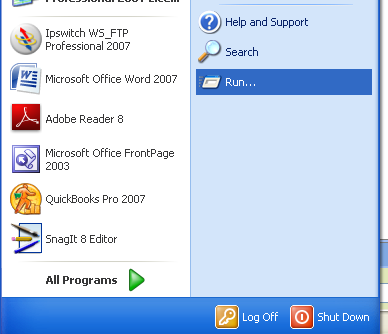
One thing I never really knew was what happened to the Run command. I figured maybe they decided it was a bad idea because it used to be up front and center in XP and earlier version fo windows

But I knew where the “Command Prompt” was in Vista, so I never bothered looking for the Run option.

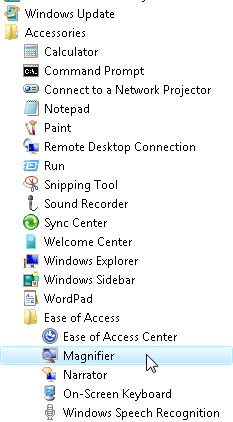
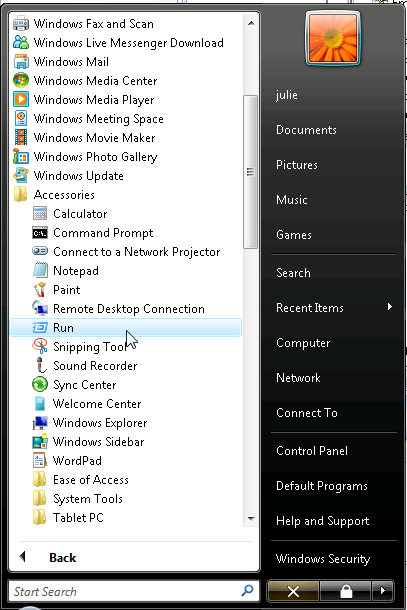
Just now I was looking for the Magnifier function – I know I saw it once (again, by accident), so I opened up the start menu, then accessories, and what did I notice? My old friend “Run”!

So back to the Magnifier. I found it easily enough using the Search (see I know a few things in Vista), but that still didn’t tell me where in the menu it lives. But I also am familiar with one of my favorite little Vista utilities, the “Open File Location” option in the context menu, which helped me see that the Magnifier is in Ease of Access

Now, if only I could remember what I wanted the Magnifier for to begin with!

Bill gates “last day” video from CES

Thanks to Mike Taulty for keeping me in the loop. For some reason, when linking directly to the video, the sound was wierd, so here’s the MSN video site where you’ll have to watch a 5 second ad first. It’s worth it!

This is funny and it is always a great reminder to see Bill Gates sense of humor and his ability to laugh at himself. I think when we had the meeting with him last month, none of us were thinking of this – we were all so serious. Sheesh!

LINQ – Learn by example

Roger Jennings writes about issues with finding examples of complex LINQ to XML queries. Boy have I been there and done that. One of the problems with learning LINQ is that you have two options

1) learn LINQ very deeply so you can do what you need

or

2) learn by example

With LINQ, I tend to start with a need, do what I can until I hit a wall, then look for examples that will help me and use them to learn even more. But it means that there needs to be a LOT of examples.

I have often likened learning LINQ as well as learning Entity SQL to learning T-SQL. Learning T-SQL has, for me, been an evolution which has occurred over some ten years. I still have to look up the Cast & Convert topic 99% of the time in the docs whenever I need to convert a datetime to a desired char format.

Even if there were 1001 examples, I know that there will always be something I want to do that I can’t find an example for and will have to rely on gaining a better understanding of LINQ in order to accomplish it.

EF Mapping to Read Stored Procs, another twist

Entity Framework easily supports mapping to read stored procedures when the query results match up with an existing entity in the model. If your query results don’t, then you have to create a new read only entity and entity set in the CSDL and a new “fake table” entity and entity set in the SSDL and then you can do the mappings. (I show how to do that in this blog post.)

Chris Snyder found a new twist. What if the result matches an entity, but some of the fields inthe result have been renamed? Unless you wanted to create a read only entity to match it. But then you won’t get the change tracking benefits of a entity with a key.