Category Archives: Data Access

Compiled Queries in Entity Framework

I was fiddling with compiled queries yesterday and thought I would share what I saw as results. This is anything but laboratory benchmark testing so take it for what it’s worth. I did only a very simple query to start with, finding SalesOrders whose total is greater than a given number.

You can do this with Entity SQL or LINQ to Entities. Here is my LINQ to Entities compiled query:

Dim compQuery = CompiledQuery.Compile(Of AdventureWorksLTEntities, Decimal,
 IQueryable(Of SalesOrderHeader))( _
 Function(ctx As AdventureWorksLTEntities, total As Decimal) _
 From order In ctx.SalesOrderHeader _Where (order.TotalDue >= total) _
 Select order)

To interpret this, Compile’s signature looks like this:

Compile(list of args, returntype)(delegate)

It takes a list of arguments and a return type then performs an operation (defined in the delegate) on the arguments. I’m defiining this compilation to recieve an AdventureWorksLTEntities instance and a decimal and the return will be an IQueryable of SalesOrderHeaders.

VB
CompiledQuery.Compile(Of AdventureWorksLTEntities, Decimal, _ IQueryable(Of SalesOrderHeader))
C#
CompiledQuery.Compile<AdventureWorksLTEntities, Decimal, IQueryable<SalesOrderHeader>>

For the delegate, I use a labmda epxression that says what to do with the parameters which is to build the query.

VB
(Function(ctx As AdventureWorksLTEntities, total As Decimal) _
From order In ctx.SalesOrderHeader _
Where (order.TotalDue >= total) _
Select order)

c#
(ctx, total) => 
from order in ctx.SalesOrderHeader
where (order.TotalDue >= total)
select order)


The whole query is tied to a variable

Dim myCompiledQuery=CompiledQuery.Compile(....

Then when I want to run the query, I invoke it and pass in the parameters


Dim AWEntities As New AdventureWorksLTEntities
Dim orderTotal=200
Dim orders As ObjectQuery(Of SalesOrderHeader) = compQuery.Invoke(AWEntities, orderTotal)

The first time the compiled query is run, it still has to compile, but after that it uses the results of the compilation and can swap in the parameters without needing to recreate the generated command tree.

You can see a big difference between running the query without pre-compilation and running it with the compiled query.
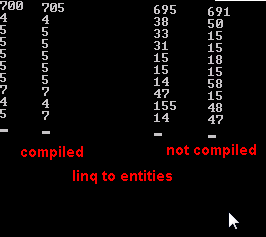
Brian Dawson does some more intense testing and compares LINQ to Entities to Entity SQL as well in this blog post. But I just needed to actually do it myself, rather than only reading about it.

LINQ to SQL also has compiled queries. Rico Mariani has a series of posts on this starting here.


nHibernate 2.0 Alpha

Entity Framework owes a lot to the feedback of the nHibernate crew who, as Roger Jennings so aptly states, “were responsible for making the Entity Framework folks finally understand what persistence ignorance is all about”.

The PI side of EF still has a long way to go, so in the meantime nHibernate continues to get stronger and stronger.

The alpha of a new version that logs over 100,000 lines of code changes was just released.

I know those guys are beyond frustrated with the current state of Entity Framework and the persistence of people like me who are curious about it and continue to share what I learn with whoever wants to listen, rather than just telling them to run away from data centric programming and join the ALT.NET wave. But what can I say. I embrace the options even if I can’t become expert in them all.

Anyway, this release is a huge accomplishment and to have it be done with the dedication of what it takes in an Open Source environmnet to roll out a tool that can be used in big enterprise applications is really impressive.

LINQ to SQL (and LINQ to Entities) performance improvements for VIsual Basic

Highlights of this post from Timothy Ng of the VB team:

“Over the last few months, the VB and Data Programmability teams were working on fixing a performance problem with LINQ to SQL (which also manifested in LINQ to Entities). The issue was that LINQ to SQL was generating sub optimal T-SQL queries when the VB LINQ queries included filters over nullable columns.”

“The good news is that the LINQ to SQL team has a fix to their code generation to recognize this pattern, and now they emit the SQL code that you would have expected to emit”

“In other words, LINQ to SQL (and LINQ to Entities – we made the same fix there) is now smart enough to pass three-value logic from VB to SQL.”

MSDN Forum restructuring for Data Access (LINQ and Entity Framework)

The MSDN forums for data access have been restructured a little.

Entity Framework & LINQ to Entities questions:

The one which has always been under “MSDN Forums » Visual Studio 2008 (Pre-release) » ADO.NET (Pre-release)” has been renamed to MSDN Forums » Visual Studio 2008 (Pre-release) » ADO.NET Entity Framework and LINQ to Entities (Pre-release). It’s still pre-release, of course.

LINQ (Released)

While there is still a general LINQ forum under MSDN Forums » Visual Studio 2008 (Pre-release) » LINQ Project General  (Yes, under Pre-Release. I imagine they don’t want to lose the content or confuse people by moving the forum), the LINQ “flavors” have now been split up and are in the “Data Platform Development” section.

MSDN Forums » Data Platform Development » LINQ to SQL  
MSDN Forums » Data Platform Development » ADO.NET DataSet (This includes LINQ to DataSet)
MSDN Forums » Data Platform Development » XML and the .NET Framework   (This includes LINQ to XML)
 
Regular ADO.NET (aka “Classic”)

1) The above linked ADO.NET DataSet forum is the place to go for all things DataSet.
2) MSDN Forums » Data Platform Development » ADO.NET Data Providers  
“Data platform development using classic ADO.NET (v 1.1 and 2.0) and System.Data namespace.”

EFExtensions and stored procs with shaped results

EFExtensions , released on CodeGallery earlier this week by EF team member, Colin Meek, has a lot of brainy goo in it. So far I’ve looked at the pieces that Colin has explained in his first post (first post ever) about the Extensions. While most of the extensions in the first part of his post are replicating what Object Services does, the last chunk displays the real benefit of having them at hand.

EF Function Imports can handle READ stored procedures that return existing entity sets. At first I was looking at the extensions to see if they can return random objects, but I haven’t seen that yet however there’s a lot to look at still. (I’m picturing a generic method that reads the columns and creates an anonymous type on the fly rather than having to go through all of the mucking with the model to make this work. Of course, this is for read-only results.)

What Colin’s post shows, however is sprocs that return shaped results. A standard function import can’t do this…it needs to map to a single entity type.

So by combining a few of his extensions, he is able to extract the different types from the shaped results and mimic the object materialization that happens under the covers in expected scenarios. Additionally, he is able to add these entities manually into the change tracker.

It’s pretty sweet and what’s funny to me is that I was trying to do something very similar to this on the same day that Colin released the extensions. I had seen them pop into Code Gallery, made a mental note and a quick blog post without digging into them yet, then a few hours later asked on the forums, “Any way to grab sets of (unrelated) entities in one database call? “. Small world, eh? Now that I have a better understanding of some of the extensions, I will have to go back and see if this does the trick.

TechEd BOF Session: Entity Framework – Is it right for you applications? (need votes)

Is Entity Framework right for your Applications? You’ll probably want to answer this question before you start digging in deeply to learn this new data access platform that will be released very soon. Does it fit into my architecture? Will my DBA allow it? How will it play with my existing solutions? This BOF is intended as an interactive discussion where there will be plenty of experts in the room to get you started with some important decision making.

It won’t happen unless it gets voted for so go vote!

EF Stored procedures – one day, two posts

Roger Jennings wrote a dizzying (in a good way) post about stored procedures that I have not even had the chance to absorb yet but it’s about creating database procedures after the fact that can be easily used with the entities and associations defined in your model.

Coincidentally, Noam Ben-Ami wrote a lengthy post on teh ADO.NET Team blog about using the designer to leverage DML stored procedures that already map directly to entities defined in teh CSDL, while the stored procedures might do perform additional functions, such as time-stamp checking. Stored Procedure Mapping

Hallelujah – Entity Graphs will be XML serializable

In the EF forums, Danny Simmons lets an EF RTM cat out of the bag.

And, this looks like it has the possibility to be bigger than just for EF. The EF team worked with the WCF team to make ENTIRE GRAPHS serializable, and in an interoperable way. If you look at Ruurd Boeke’s blog post,Circular references with WCF: solved a different way, about how he  achieved this, you can see examples of how WCF serialized entities before (non-interoperable) and after his own tweaks. Ruurd has been thinking about this problem for a long time, not just for EF, but for WCF in general, because it’s the way that WCF serializes that causes the problem.

So the question is, did they just implement this specifically for EF, or will this have a broader impact? We’ll see when the next CTP (as per Danny’s comment, he says CTP not Beta4) of EF comes out.

Another Entity Framework Team member has started blogging

It’s great to see Colin Meek finally blogging. Colin has been a wealth of information on the MSDN Forums for Entity Fraemwrok related questions. It is also COlin who posted teh Entity Framework Extensions on CodeGallery a few days ago.

Colin talks about the extension in his first post and how they can be used to handle a variety of Stored Procedure scenarios in Entity Framework.

For what looks like a pretty complete list of the blogs of the Entity Framework team and others on the Data Programmability team at Microsoft, see the Resources page of the DataDeveloper.NET website.

Thanks to Alex for the heads’ up….

Tip for working with embedded Ent. Framework models with Beta3

Because of a bug in the way the schema files are created, the behavior for embedding the model into your assembly and the impact on using that assembly in other projects is a little funky. This will change with the next iteration of the EF that we will see as it has been fixed.

In the meantime, there are two things to keep in mind.

1) When you compile, even if you want the files embedded, choose the Copy to Output Directory option for Metadata Artifact Processing, then build, then change the option to Embed in Output Assembly.

2) If you make a change to the model and rebuild, after it is already being referenced by another project, you may or may not get the changes reflected in the assembly and therefore the client project will still fail. In most cases, doing the 2-step build will do the trick. In other cases, it is necessary to go into the bin directory of the model’s project and delete all of the schema files (csdl, msl & ssdl) or just delete every thing in there, then do the two step rebuild again.

As I’ve been working on samples over and over and over, and adjusting my model, I’ve gotten into the habit of doing this.

One easy red-flag that you need to do this is if you get an error message complaining about C-side vs. O-side. That means that something in the CSDL is different than the classes (O=Objects) that were codegen’d. So you while the assembly does have the updated classes, it doesn’t have the updated model.